THIS WEB PAGE INCLUDES
EXAMPLES OF DOCUMENTARIAN GEO-POETRY PRACTICE
POEMS FROM RESIDENCY WITH MIDLANDS METROPOLITAN HOSPITAL
POEMS FROM “IN THE GARDEN” WITNESSING PATIENTS AT BIRMINGHAM WOMENS
*GEO-POETICS for the UNDERSTORY COLAB* Spring 26
Story
Early morning walk along a canal in a nature reserve in Gloucestershire, Understory: gathering to reflect on year 1.
G
Drones are these fat bees whose sole purpose is to mate with the queen. They don’t make honey. People think they’re lazy because they don’t do anything but ‘lull through the air love drunk. They have these huge round bulbous eyes.
She gathered the air with her wide hands and fly swatted the shape of these massive lenses to her own.
They cannot forage, and don't sting. They literally fuck other queens from other colonies, collecting knowledge. It’s like they’re out in the field gathering source, then come to the hive to impregnate her, multiple drones at a time. It’s like they give the queen the local news from the others, instructing the genes of her children, preparing them for the world.
It’s a bit like us here really isn’t it?
Poem
Reflective Process
Psychology of Poem (drones)
-
June 2026.
What are you working on in the world?
What would you rather?
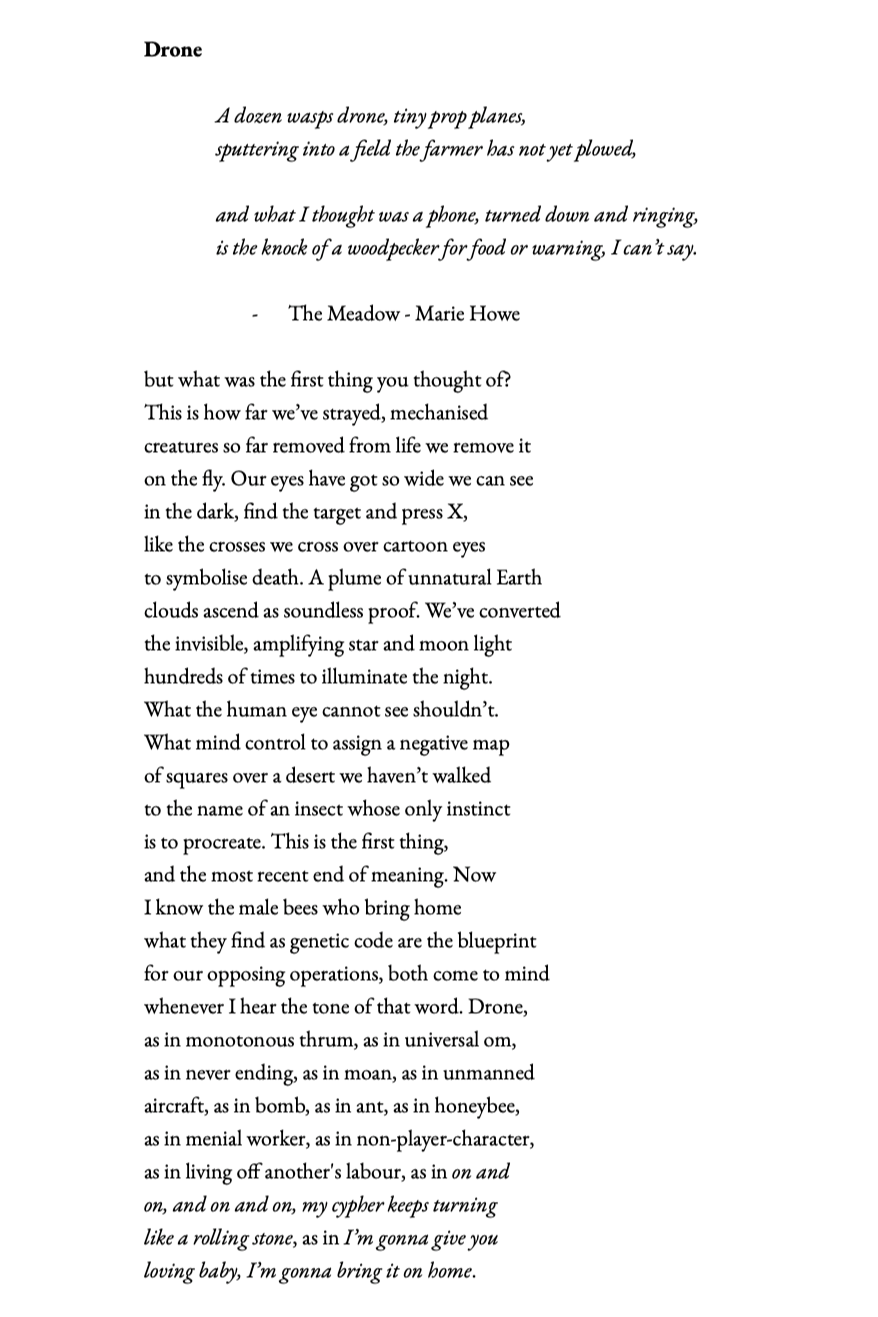
Georgie taught me about drones, lazy little sexy bees with huge eyes impregnating the queen multiple times, and I've thought about the word since. I took it to my writing groups to hear our collective understanding of the word. I've read poems and definitions, researched the etymology. The name didn't pull the image of a bee to mind when I heard it. The poem was my first recall, and I am not alone. No-one in my writing groups defined the word as its original meaning, the male honeybee. They knew it as the sound, or as idleness, or remote-controlled surveillance machines (geospatial). What a shame it is we've wandered so far away from truth. I've been on a mission of remembrance in many of the interactions I've had over the last couple of months, telling anyone who'll listen about drones, and how all the different definitions of drones since are informed by them.Georgie brought this natural phenomenon as a metaphor for our collective reflections on the work all organisations have done over the last year, bringing our codes of practice and experiences into the hive of the Understory, as pollinators of practice, procreating our senses and minds through idle conversations, stories, and questions. What questions do we ask to bring about change, or deliver inner confidence and strength, to create action in the many fields we find ourselves rewilding?
I appreciate how like the honeybee we are, and how unlike the humanless drones we are. There is enough reflection on the themes and topics present at our gathering that there is no need for me to go on and on about what we did and what we found. And if I drone on about it, I risk losing you, and doing the poem an injustice. This is about honouring the ways the more-than-human relate as maps for our own relations, and recognising the gifts of sharing influencing how we navigate now and the future, together or alone.
-
Drone Honeybees.
Water, Canal.
Howe, Marie. "The Meadow." What the Earth Seemed to Say: New & Selected Poems, Bloodaxe Books, 2024, onbeing.org/poetry/the-meadow/
Georgie, Onion Collective, the Understory gather April 2026.Erykah Badu:
Badu, E. (1996). On & on [Song]. On Baduizm [Album]. Universal Records.Led Zeppelin:
Led Zeppelin. (1969). Bring it on home [Song]. On Led Zeppelin II [Album]. Atlantic Records. -
During a reflective conversation with Deb and Lorna in CoLab on this piece, I have bought war into the Understory world. We are protected in this little bubble of awesome, important work, with such confident change-makers, creatives and alternative developers together. It’s gorgeous because of what else goes on. Idyllic because we recognise our privilege, and know what else goes on.
As a collective, we are forgetting. Isolated, we can’t remember.
Our longing, our Heareth, is monopolised. I call it a colonisation of the mind. We can’t think as we drone out with consumerism as an easy, sometimes necessary break from ruin.
We’re losing our words, our grasp on things, our hold. This work then is about remembrance. We’ve read it so often this re-membering, but its true and needs saying again and again. My son should know, I should have known the Drone is a bee. How devastating it is that the other is on his Christmas list and we are only in Summer. What have I done? What are we all doing? Here, now, a small witness of remembrance has your attention, what next?
I pack my shopping trolley with poetry books, lug them to a stroke ward, (people who could and are by some deemed destitute from the vulnerable populations, who would experience the first and worst consequences of climate change) and I hold a mans hand as he tells me its Opera music that gets him through, and a woman whose image of her children are stabilising her after walking for the first time for 8 steps in 6 months, and a gentleman who cannot find his words and I speak them, as if interpreter as he tells me whatever happens is Gods will. I kill the aphids eating my vegetables and worry for the ants. Keep doing what you’re doing whichever one of you is reading this right now, I am so grateful for the care you give.
It’s a bit like The Lost Words *Robert McFarlane in physicality this is, walking along a canal, a river locked in, with women, teaching me the true meaning of the word roll-playing a bee.
*GEO-POETICS for the UNDERSTORY COLAB* Winter 25/26
Poem
Reflective Process
Psychology of Poem
-
March 25th 2026.
After the rare occurrence of a day of all weathers, I finally come to this piece. Both the poem and this accompanying reflection emerge in tandem with four seasons appearing all at once on a day in March, barely a week since the spring equinox. Today it rained, winds thundered through the forest without the resident ash trees to break their sound, soil-dust twistered across the road onto the path sanding my car windows and wowing my children, clouds of all colours swept across the sky, at times its been so overcast there was no sign of horizon, hail literally pummelled us in the playground, and when the sun broke through, it blind everything white like a halogen bulb over a vulva moments before birth.
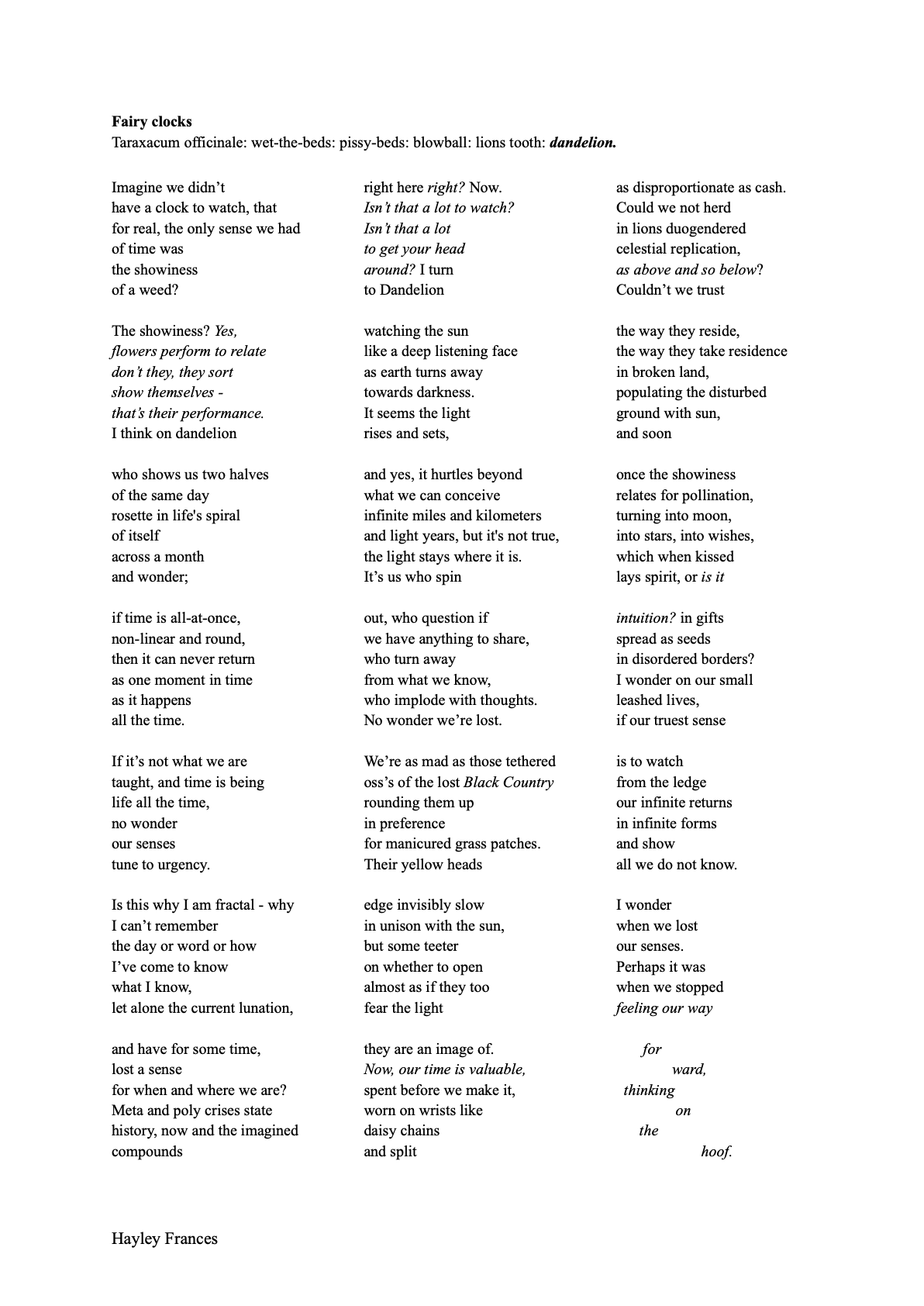
It would be wrong to say I just sat here now to write the preceding poem on Dandelion in one long breath. After the gathering in Dudley in February, I’ve gone through pages and pages of handwritten notes, typed them up, cut them into strings of sentences and slivers of words, as if shredding them for the compost, categorised them in their fields to find patterns, fractals, and a way to make sense of the weekend with what I documented. I pieced them together into different versions of communication, sliced a sentence from Lorna in two and interjected notes from a walk where I almost got lost with Georgie (even though I live there, I have no sense of coordination), split speculations from Simon into quarters and interlaced segments of the self-mobile by Katie, sponged uncertainty from those who felt they couldn’t locate their knowledge, and mirrored them with those who could but questioned how to package them into gifts to be composted by the rest of us. We lost our sense of direction - even with instructions - it was as if we’d landed where we are out of nowhere, with no knowledge to share, and also too much knowledge to share; what and how do we choose? and also, too much to take in. Jo covered all bases. It wasn’t the composting, the worm, the beings, the directions, the play-test of what a Compost Party could be, and how our previous experience relates and could enhance the hypothesis - that was the result and what came out of it - it was that we had only known compost and metephoricalised (this is a made up word btw) compost as theory for our work, and dematerialising our knowledge needs practice. There is also something revealing and performative in collating our experiences for others to consume, and in a sense, we look at the potential of our knowledge through the eyes of each other as a way to sift through what we know, and put our choices, our knowing, on a ledge for others to prize through their gaze. This takes courage. The funny thing is, whilst asking all the questions on the worthiness of what we bring and what we didn’t know, we turned up bundles and bundles of the stuff - a paradox in active relation.
Deep listening had given me a lot to process, and we all felt that post-party, so I couldn’t feel a way into what the poem was going to be until witnessing the literal act of gift-giving between Sam and Sally. At the table after the Honourable Harvest of potatoes, a poster of Dandelion was given to Sally to honour her belated birthday. I looked over Sally’s shoulder at the art, an illustration of a dandelion with symbols such as the infinity figure of eight, the flower as flower and a seed head, medicine, and wish, which gifted me the subject (or voice?) to pull it all together. I saw in that poster on the table surrounded by women in candlelight, watery eyes, smiles lit by the golden hour glow of flames, all of the knowledge gifts and words and strings of sentences I’d collected as individual wish seeds pulled back in time to the flower of life we dispersed from.
I recalled Deb’s inclusions to the heap, hand-tied reflections of knowledge from the Green Man myth, along with a hand-drawn zine of Dandelion from Routes. I recalled our whispiness, uncertainty, excitement, disruptions, and anxiety of the collecting, travelling, presenting and understanding, the worry of not getting it right or not having anything tangible to share or having too much to share or waiting for confirmation on how to pull what they could potentially share together at the very last minute. I recalled the planning, the exhibition, the Council of all Beings, reams and reams of study, Stories of Home, the Spiral Journey, School for Climate Justice, Pockets of Hope, as well as all the experiences we brought to the foreground from our own lives.
It all felt like everything was happening all at once at the same time against the clock, with compost symbolising the slow time we need to process this stuff. My whole body goose-bumped at the conjunction of us all.
However, Dandelion was projected to me as a concept for the containment and dispersal of this work through the poster, and was not ready to emerge (speak to or through me to make sense of things as a poem) before they arrived in real time with the compass of the seasons. Have you noticed them, returning with the spring Sun as a symbol to stay balanced, as an arrow to the time of year? I’ve never noticed the timing of their arrival before. These two-sided beings rise with the duality of the day, as light and dark even out at the equinox. How could I forget? They poked up between cracked concrete in the grove I was raised in. They danced in my garden as a child. I’ve blown them, picked them, ate them, and never, not once, took a moment to notice their recurring births. This misunderstood flower declared weed was just here all the time in my mind (and this is where I connect the dots) - I imagined them perpetual - imagined. Throughout the whole time we were together, responding to what’s happening out there, the materials of our gifts, and the mapping presentation showing us the more than human in our region in bio-regional mapping, which showed human interferences on land, I kept turning to Lizzie and repeating ‘we’ve lost our senses’ and ‘we’re losing our capacity to imagine’ - the we being society.
Because we’re primed to keep falling long and hard into the notion that the Earth is abundant with life at all times - an imaginary perpetual summer - productivity rules how we feel about how we spend our time. I never noticed the mutual relationship between the Season, the Sun, and Dandelion. Even now at the cusp of Spring, we’re apprehensive for the long dark night, and must, at all costs, busy ourselves with doing to keep things going. It’s miraculous to me they turn up now, and obvious too. Of course! A flower with a life cycle of one month, half sun, half moon, like one day spread over the cycle of a woman, of the moon, at the point, the whole Earth experiences the same light as there is night. I mean, balance, take your time, listen to the Seasons, these little beings start to scream from the colour of their small round heads. Don’t rush now. Collect us. Take our medicine. Let us start the honey collection. Spread yourself only when you’re tended to.
As if by magic, they rear their heads in long leafed bouquets just as the entire Earth at once experiences an equilibrium of light and dark (it's so magic I must say it twice). And no, it doesn’t seem that equal out there, and it would be wrong of me not to recognise the catastrophes of the overculture's demise, climaxing - or so it seems - into its own implosion. Notice how the infinity symbol, as a figure of eight loops out and back in its own sort of spiral, as if imploding at the centre and spinning back out to come back in - perpetually. Yet here we are, gathered, or we were, together, not knowing all that we know and also knowing everything we have come to experience. We are it you see.
Even with this spark of wisdom I’d forgotten, and lost sense of, I still felt against the clock and wanted to get the poem out quickly, responding immediately to the gathering, like I did before. Heron came at once, but this one didn’t come naturally, and I was forcing it, but art doesn’t work that way, nor does sense making, nor does nature. Spring hadn’t arrived, the Dandelion had no voice seeded in the ground. These things take time, and we’re trying to make the time matter. This work is so gorgeous, and the side effects of the tech, as an engine for collaboration and play, as a way to map what we’ve got and foresee mobilisation past the implosion we choicelessly a part of. Our choices are here, and we make the best we can. There’s no time. I’ve had a shit time. This won’t work with the time-poor. We’ve got to make time for that. There’s not enough time. We need more time. We’re just so busy. We’ve got to squeeze that in somehow. Where is everybody? What are we doing now? Each of you all said some version of these flippant quotes about time. Time being an issue is embedded in our culture.
It’s a lot, isn’t it? Yes, it’s a lot. Too much even to remember what we’ve forgotten and know what we know and carry on thinking everyone else knows, and then reassuring ourselves out of panic, no one knows what they’re doing. HA! YES! They’re all sensing their way through, trying to do something with the nothing they know.
We are our own arrows, and the arrows for those we work with or on behalf of. Here, look at this, we say, pointing to a thing we know you’ll like, saving it, sharing it, gifting it. Here, come this way we say, pointing to a new direction, to a space, to a dwelling, a craft, a game, outdoors. Go that way we say, then there, imagine the trees are looking at you, imagine you can smell the rain, this is the sense we’re most accustomed to. Go ahead, give it a go, what does yours look like, where’s important for you, what do you notice? and we point —> look at that bird, look at that hail, the clouds made that, look at where we are going, look over your shoulder at that view, pick and blow that fairy clock, make a wish, isn’t it amazing? We give directions, locations, and pinpoints like the hands of a clock. It’s not time, it’s a map, and it’s here in the Dandelion, well, until the long night arrives come October, and even then they lullaby us into the soil, rest now child, tuck yourself in, share your dreams in the warmth of the Earth.We don’t give ourselves enough time.
This is how we return, how we find our way home. -
This poem is written as poetic witness. A lot of the language in the poem was shared in some form at the gathering. I wanted to put so much of it in italics to show the voices but I was selective.
The showiness of a flower piece was said by Rachel, and this was a phenomenon for me. I always question if I have anything to show, to prove, some outcome, some product, but I witness and relate, thats my ‘performance’. Its not isolated to me, Sam and Simons work is playful and relational. In fact, everyone contributing to the understory’s work is that in some form. We have different roles, but they are much the same.
I’ve written it as a sextet, six lines for each stanza, the last is a poor attempt and making it look like wishes being spread. I tried to do a ‘fractal’ poem but they are ridiculous. A pattern of six felt right.
oss’s is from Sarahs spectacular Black Country language night.
Feeling our way forward is taken from Zara who shared with me at the house that that is her way of working, and as Lorna inquired on if she had intuition, or what intuition even is (also in the poem), the two seem the same.I’ve layered it together as best I can.
The rest I’ll leave with you. It’s all in there. -
Jo - Compost Party Work
With the process of collaging your quotes into the poem, apparently David Bowie did it with his song writing which you can watch about here;
https://www.youtube.com/watch?v=6nlW4EbxTD8Cerys Matthews show on 6 music - Time Zone tinkering and disappearing dialects with Ariadna Güell Sans;
https://www.bbc.co.uk/programmes/m002srsc
Polycrisis & PostrealityExplaining Polycrisis and Metacrisis -Framing humanity's interconnected crises, existential risk, the prospect of collapse, and differentiating polycrisis vs. metacrisis;
https://www.realitystudies.co/p/explaining-polycrisis-and-metacrisis
T.S. Eliot’s Four Quartets (oh my)
https://www.lettersjournal.org/wp-content/uploads/2017/05/fourquartets.pdfThe Spiral Journey
https://spiraljourneyworkthatreconnects.org/Ekho Collective - Routes Dandeline Zine. Debbie.
*GEO-POETICS for the UNDERSTORY COLAB* Autumn 25
Poem
Attempts to rewild quarry wasteland
I am thinking on a pond how
heron, liminal, scales sky and spawn
stood on one leg. How without
the dip scarred from rock
chipped and mined outlandishly
by hands for water to suspend
amphibians, invertebrates, and
microscopic water-lives, heron
has no space to sweep and step in.
How that stick leg stirs the lightest reverb
(so slender heron’s entrance, sound as a drip)
to the gargling blurred edges
marked by reeds, and water mint.
How alive pond is. How
chlorophyll concentrates
on spreading across the surface.
How surface hides who swims
with reflections of imagination, as if
a closed window to the sky
was splintered in place on
what was common ground.
How heron steps in and stands
still for ages, and if we noticed
this scene, would we see this
feathered bridge a part of it
for a time being, and long enough
for fish to reveal themselves?
Reflective Process
Psychology of Poem
-
Getting to grips with perspectives on communities, towns and villages across a regional landscape of Derbyshire in central England, I started to imagine a Pond. Listening to Racheal from MAKE/SHIFT speak about what it means to work across the Amber Valley within and between boundaries shaped and subdivided by councils, communities, landlines, class, and heritage, territories related to community relationships (or the lack there of), systemic capitalist infrastructure, the landscape of the lands formations, districts of touristic natural beauty, and geological compositions beneath the surface. Pond emerged as container for the concepts.
Derbyshire’s ground transitions between the Carboniferous limestones of the Peak District and the Coal Measures, clays, and ironstones of the Derbyshire and Nottinghamshire coalfields. These deep formations play a quiet role in how the area is boundaried and inhabited, as land had its uses for resident livelihoods. What struck me most, however, was how towns and villages within Amber Valley are managed, segregated and governed by a multitude of council expressions, that overlap, contradict and create tension (shifts in power and support creates a sort of confusion over who’s in charge of what and how).Racheal shared geological maps of Amber Valley with me, explaining how mine wounds are sometimes filled with rubble and waste before being sold to developers. These are precarious grounds, homes built on instability, risking sinkholes, gas leaks, and collapse. It taught me that regeneration, whether ecological or communal, depends on what lies beneath: the unseen strata of trust, history, and care.
All of this creates difficulty in producing work that crosses boundaries, yet provides entry points to support communities in re-establishing relationships with land, eachother and power through creativity (essentially, social change for the benefit of Amber Valley’s people). MAKE/SHIFT, moving at the speed of trust, are trying to compassionately create unity between these differing constituents *so I understand.
Andreas storytelling the counter mapping she facilitated relationally with key member of the community (Clare/Claire), meeting them through a mutual friend at a music night, then sitting together to map the strengths, energy, and juice of the area, I felt the sounds of that meeting in the reverberations of the Pond, and saw how a stepping in to witness an individual’s importance, a step / a droplet / a leg / an ear and a sound, in this sense of the story Andrea meets the surface of a place. With a witness of no judgement through intentional, active listening, surface / waterlife could reveal itself; (Clare/Claire) was able to express everything she carried regarding her position, relationships and role within the community, and what was happening in her place.This uncovered a collective of active community members (one might term cornerstone species) later gathered to recreate the counter map on a wider, collaborative scale, a kind of community council representing a variety of professions and ways of being, though not a council as we are conditioned to understand them in the context of bankruptcy, invisibility, austerity, and landlordism.
Together they mapped places of strength, working from the micro to the macro, from the step in, to the blurred edges.
Listening to Angela’s story and to Racheal’s reflections at MAKE/SHIFT, I could see the layers of it all - land, people, creative expression, organisation, council - like water-life, a pool (pooled together through invitation) of common ground, the UNDERSTORY.MAKE/SHIFT became, in my imagination, the Heron at the Pond’s edge.
-
I say “I’m thinking on a Pond”, not of a Pond, because the sky reflected in the water becomes imagination itself; theories, acts of creation, routes to counter map, sense making, myth, historical contexts and land relationships; the mind’s reflection. I am also the Pond and I have arrived on it as Heron too.
The Pond focusing my listening, and sense-making, in a sense too processing (*I had mentioned to Racheal the day before how our use of language makes us human-doings. We say processing rather than composting or digesting). Putting myself in Racheal’s perspective as she spoke of boundaries, council structures, and community differences (rooted in heritages of mining, farming, and social services mentioned above) I began to see the beings of the Pond as metaphorical representations of the people of Amber Valley and how the blurred edges of the Pond represents the blurred edges of the boundaries of the land and the blurred edges of MAKE/SHIFTS community practice. I am in the scene as one of the beings, yet the “I’m” is also Andrea, Racheal, Lizzy, and Clare/ Claire and all in the community, landing liminal, but also swimming as community species.
I write feathered bridge because Heron pale blue, cloud white, with a keen eye, in the Pond becomes a bridge between worlds: one leg in water, one tucked in, head above the reeds and skyward, feet submerged in sediment.
I write Water Mint because I didn’t know it grew near Ponds until Lorna shared she was seeking Kin at Craft Wood, and couldn’t find it. Around the kettle over the fire, we discovered there was a hidden Pond at Craft Wood, so Water Mint makes it in.
The fish revealing themselves only in the patience of Heron, I do not see MAKE/SHIFT as feeding on the population of Amber Valley, but as part of this ecology, project by project, as time-being.
The Pond became a container for understanding, and the Heron a reflection of how to operate across a region. Amber Valley as a Pond, with all its plant life and animal species, and MAKE/SHIFT, as liminal and bridge like as their name suggests, recognises shifts in boundaries of the land, shifts in perspectives of the people in different subregions of the region, and sees all of this from a skyward, birds eye view of the land, but only having done the work on the ground and mapping this with actual maps of the area - scaling both SKY and SPAWN.
* I didn’t know then that the image on the Amber Side Signal chat was of an actual Pond / a pit lake born from a mine’s wound. That discovery deepened everything: the sentience of the land, and the telepathy through gathering us in residence. What magic.
The Pond became a story of potential too. After writing, the poem handed earth’s ability to heal its wounds with life, more-than-human life. It speaks to how we might make havens for our re-commoning with land, giving power and showing reverance to all who live. Heron as MAKE/SHIFT steps in and waits, at the speed of trust.
The Pond is both scar and potential, like landing on an idea, an act of creation, a new way to map relationships across communities, to WITNESS and EMPOWER the Understory. There is a sense of mining too, mining an understanding from the perspective of community for the benefit of those we commune with, for the Understory.
There is a sense of mining too, mining an understanding from the perspective of community for the benefit of those we commune with, for the Understory.
*** P.S. A Heron flew past the window during our gather, after I shared I had the image of him at the table.
*witnessing poet, storytelling through poetry for patients at MMUH.
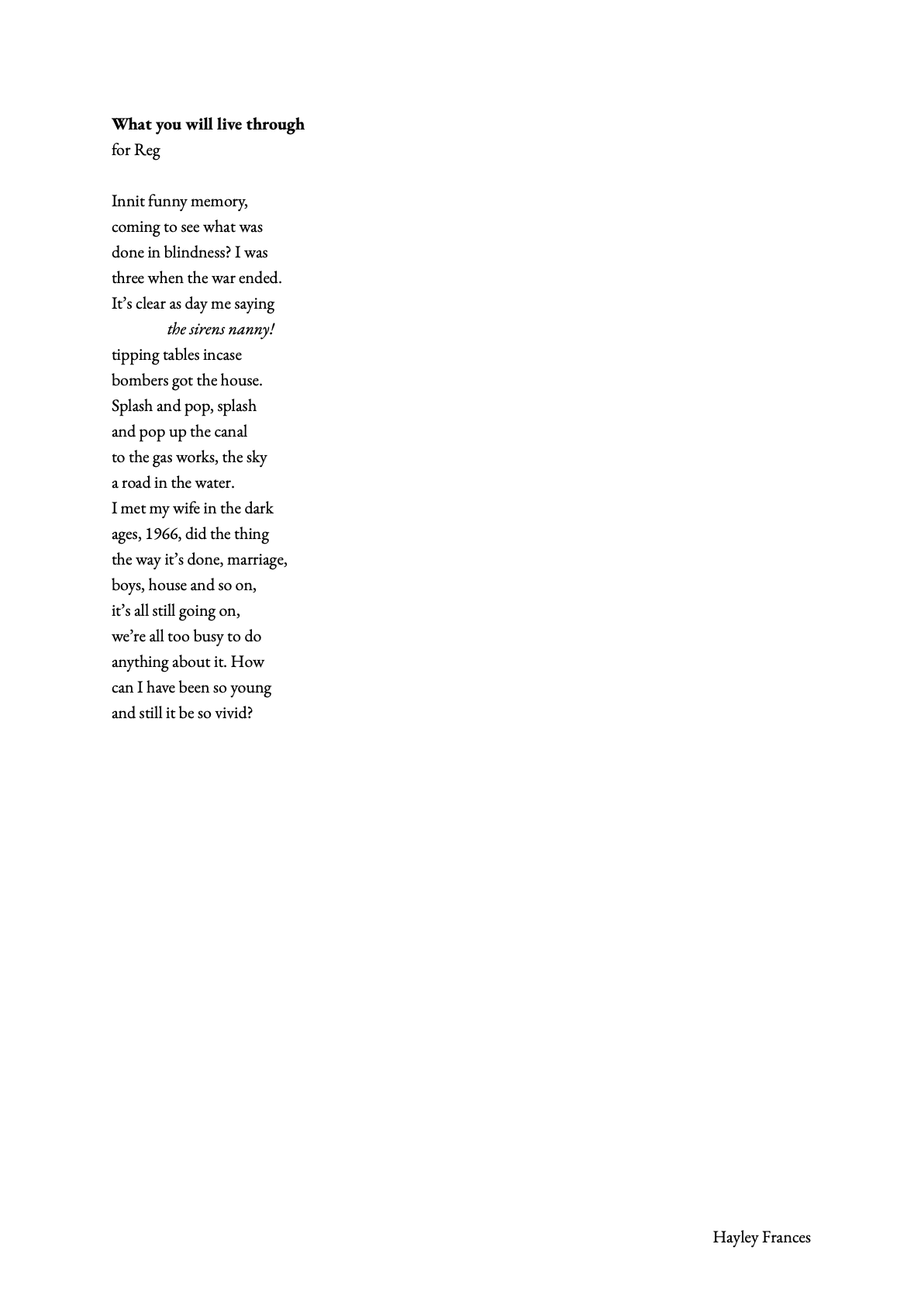
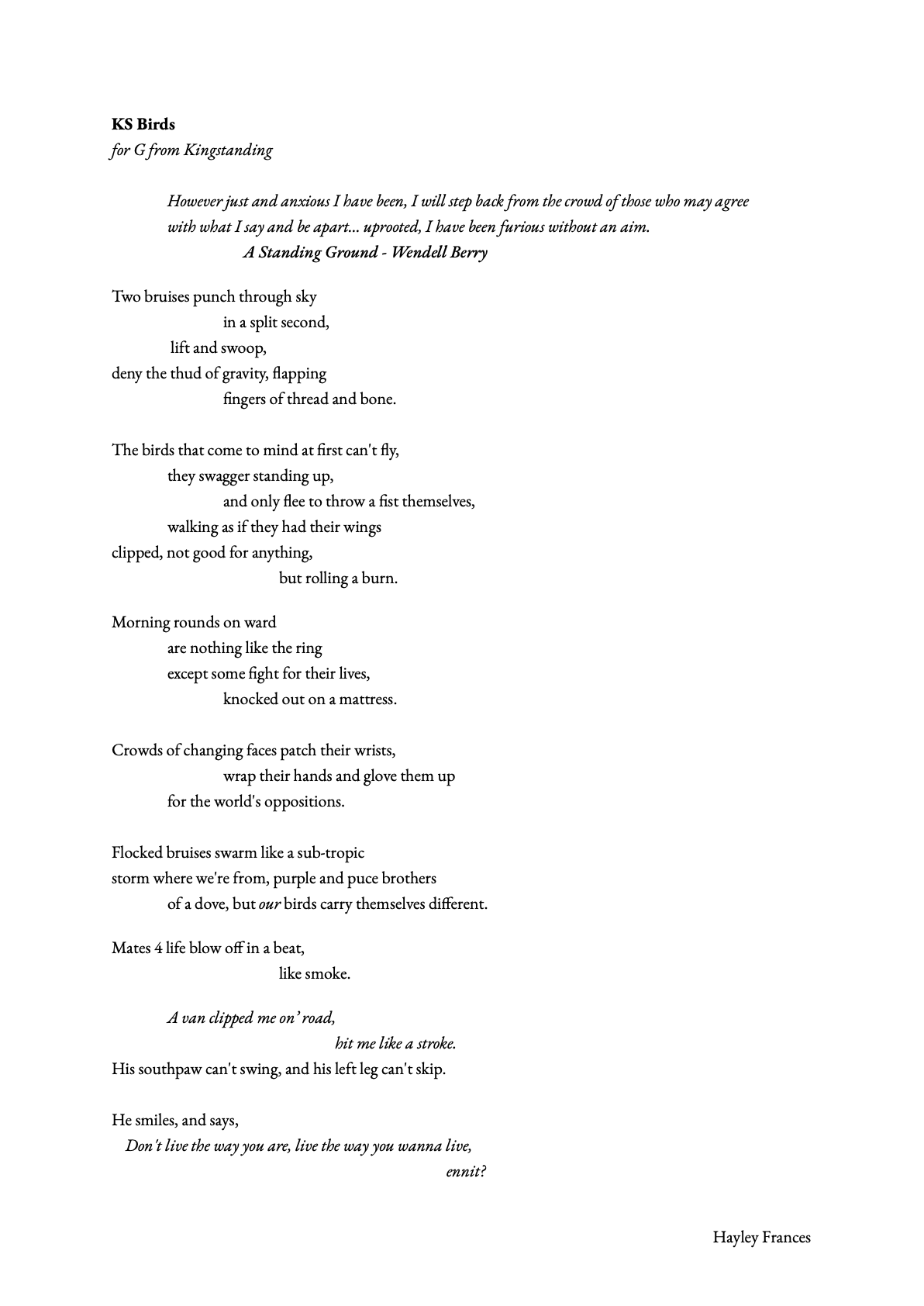
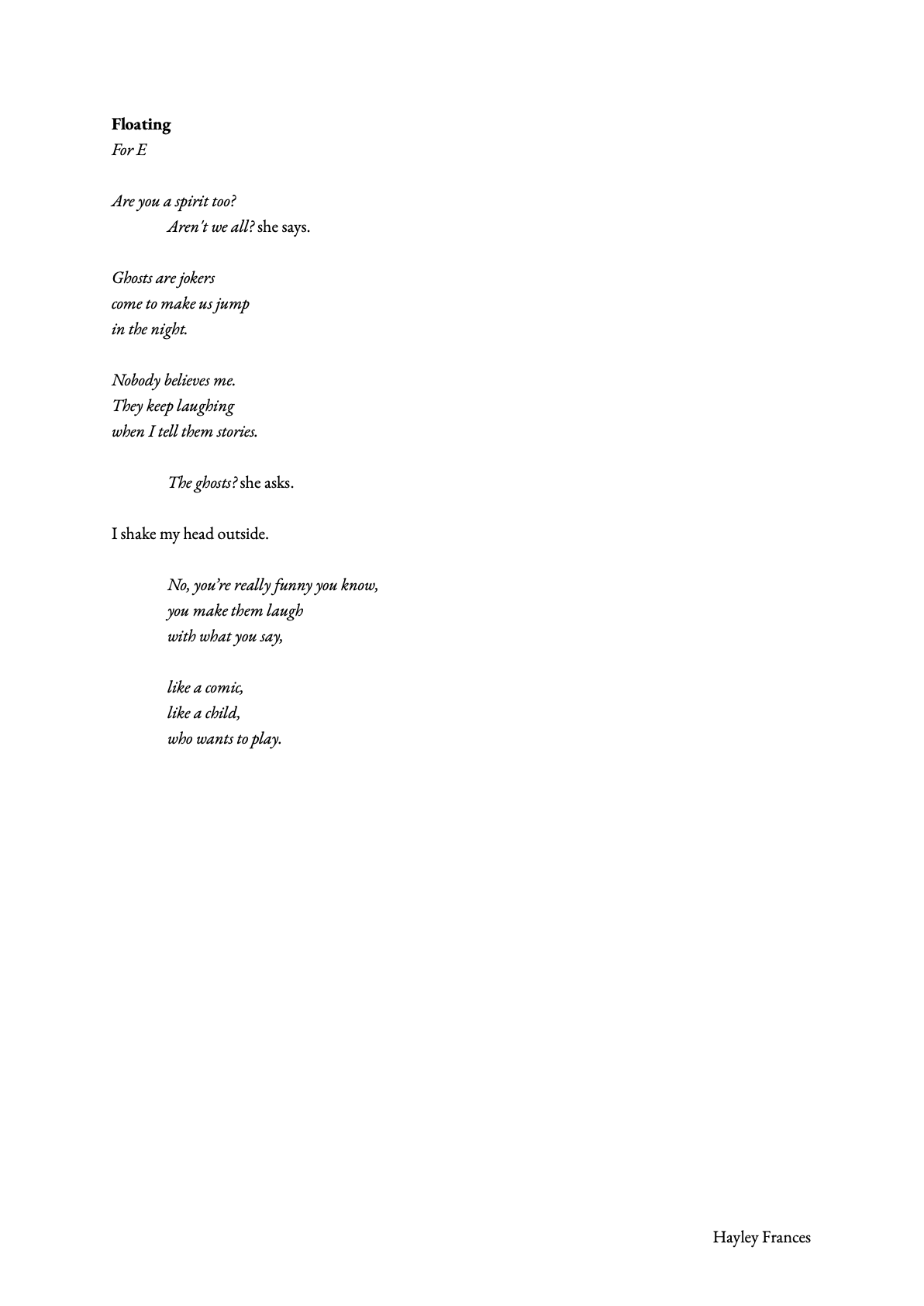
*witnessing poet, storytelling through poetry for patients at BHAM WOMENS.